
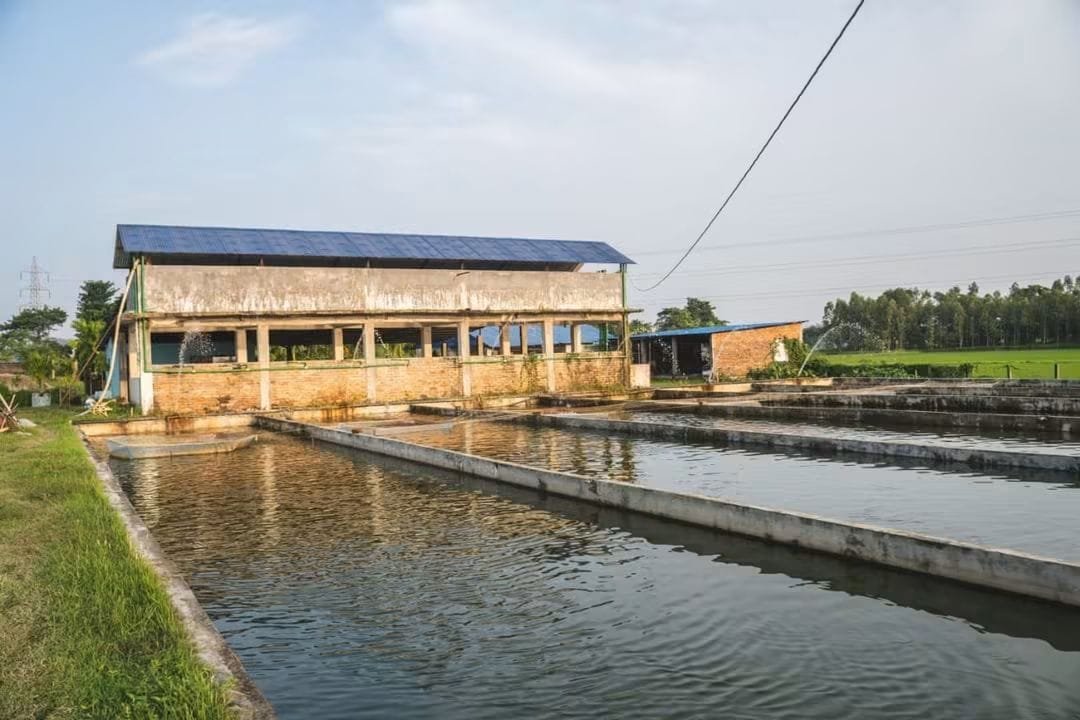
Nepal grew 84,039 tonnes of fish in ponds in FY 2080/81 (2023/24), almost three and a half times the 24,295 tonnes of 2007/08. Yet the average Nepali still eats about 3.9 kg of fish a year, against a world average of 20.7 kg. A new national aquaculture assessment puts the official figures side by side: where the fish is grown, which species, how farmers feed them, and what holds production back. This post walks through the main findings. The full report is free to download at the end.
Read the numbers carefully. Fish production, fish availability and fish consumption measure different things. Production is what farms and rivers yield. Availability adds imports. Consumption is what people are reported to eat. They should not be swapped for one another.
How much fish Nepal produces
The Ministry of Agriculture and Livestock Development’s official agriculture yearbook for FY 2080/81 reports these national figures.
| Indicator, FY 2080/81 (2023/24) | Figure |
|---|---|
| Fish from all aquaculture | 102,403 t |
| of which from ponds | 84,039 t |
| Total fish production, including capture fisheries | 123,403 t |
| Fish available per person (production plus imports) | 4.29 kg a year |
| Households farming fish | 69,842 |
Pond farming has grown steadily. CFPCC’s series shows pond production rising from 24,295 tonnes in 2007/08 to 82,161 tonnes in 2022/23. The ministry’s figures for FY 2081/82 (2024/25) put it at about 88,254 tonnes from 15,707 hectares of water.
| Fiscal year | Pond fish production (thousand t) |
|---|---|
| 2007/08 | 24.3 |
| 2012/13 | 31.2 |
| 2015/16 | 48.5 |
| 2018/19 | 62.7 |
| 2020/21 | 73.7 |
| 2021/22 | 77.3 |
| 2022/23 | 82.2 |
Where Nepal’s fish is grown
Fish farming in Nepal is very uneven. Madhesh Province alone grows more than half of the country’s pond fish, and Karnali grows less than one part in six hundred.
| Province | Pond fish, FY 2080/81 | Share |
|---|---|---|
| Madhesh | 48,456 t | 57.7% |
| Lumbini | 15,909 t | 18.9% |
| Koshi | 9,378 t | 11.2% |
| Bagmati | 5,423 t | 6.5% |
| Sudurpashchim | 3,202 t | 3.8% |
| Gandaki | 1,546 t | 1.8% |
| Karnali | 126 t | 0.15% |
| Nepal | 84,039 t | 100% |
The FY 2081/82 figures keep the same order: Madhesh 49,939 tonnes, Lumbini 17,138 and Koshi 10,235. By district, Bara leads with 11,957 tonnes, followed by Dhanusa (9,455) and Rupandehi (7,358). Karnali stays at the bottom with about 133 tonnes.
Terai: the commercial fish belt
The Terai has warm weather, flat farmland, water, and working networks for fingerlings and fish sales. The main districts named in the assessment are Bara, Dhanusa, Saptari, Siraha, Rautahat, Rupandehi, Kapilvastu, Morang, Sunsari, Jhapa and Kailali. Farms here run carp polyculture in earthen ponds, semi-intensive and intensive carp farming, tilapia, pangasius, rice-fish systems, and farming with bought supplementary feed.
Hills: trout, cages and hatcheries
Chitwan, Makwanpur, Kaski, Tanahun, Dhankuta and Ilam suit smaller, more specialised farms: rainbow trout in cold running water, carp in suitable ponds, cages in lakes and reservoirs, hatcheries, and fresh fish and trout for city buyers. Chitwan stands out because it has both established pond farming and easy access to large markets.
Mountains: low volume, real niches
In Mustang, Manang, Jumla, Dolpa, Humla and Mugu, the water is too cold for warm-water fish, the season is short, and feed costs a lot to carry in. The assessment’s point is that low pond output does not mean low potential: where water is clean, cold and reliable, trout can do well.
Koshi and eastern Nepal
Koshi is the third-largest fish-growing province, with 10,235 tonnes in FY 2081/82. The assessment names the Morang, Sunsari and Jhapa cluster as well suited to commercial carp farming, feed supply and hatchery services, and Biratnagar as eastern Nepal’s main city market for fish. This is the area where Birat Agri runs its own ponds and hatchery and makes its feed.
Which fish Nepal farms
Carp are the backbone of Nepal’s pond farming. Research cited in the report singles out silver carp, common carp and mrigal as large contributors.
| Fish | Scientific name | How it is mainly farmed |
|---|---|---|
| Rohu | Labeo rohita | Carp polyculture |
| Catla (Bhakur) | Catla catla | Surface-feeding carp |
| Mrigal (Naini) | Cirrhinus mrigala | Bottom-feeding carp |
| Common carp | Cyprinus carpio | Pond culture |
| Silver carp | Hypophthalmichthys molitrix | Plankton-based culture |
| Grass carp | Ctenopharyngodon idella | Plant-eating carp |
| Bighead carp | Hypophthalmichthys nobilis | Plankton-based culture |
| Nile tilapia | Oreochromis niloticus | Warm-water intensive culture |
| Pangasius (pangas) | Pangasianodon hypophthalmus | Intensive commercial culture |
| Rainbow trout | Oncorhynchus mykiss | Cold-water raceways |
How fish farms in Nepal are run
Carp polyculture is the oldest and most common commercial system. Several carp share one pond, each feeding at a different depth, so the pond’s natural food is used from top to bottom and all of them can be harvested together.
| Carp | Where it feeds |
|---|---|
| Catla | Surface |
| Silver carp | Surface and mid-water plankton |
| Rohu | Water column |
| Grass carp | Water plants |
| Mrigal | Bottom |
| Common carp | Bottom |
- Semi-intensive farming adds feed to the pond’s natural food. The routine is pond preparation and liming, fertilising, stocking good fingerlings, extra feeding, checking the water and sampling the fish now and then.
- Intensive farming stocks more fish and relies on pellet feed. It needs a steady pellet supply, enough dissolved oxygen (aerators where needed), regular weight checks and disease control.
- Cage culture suits some lakes and reservoirs, within what the water and the rules allow.
- Trout raceways need a steady flow of cold, clean, oxygen-rich water, extruded floating feed and frequent health checks.
- Rice-fish farming is still tiny: 17 tonnes from 49 hectares in FY 2080/81.
How Nepali farmers feed their fish
Feeding ranges from nothing at all to factory-made pellets: natural pond food (plankton and bottom life), rice polish and oil cake, farm-made mash, sinking pellets, floating pellets, and extruded trout feed.
A 2017 publication by the Network of Aquaculture Centres in Asia-Pacific (NACA) reported that farms used about 12,000 tonnes of pellet feed a year, roughly a third of it imported from India. About 60% of carp farmers used pellets or home-made feed; the other 40%, mostly small farms, relied on the pond alone. These are 2017 figures, not today’s market.
The assessment gives working protein targets for each fish. They are guides for feed makers, not official national standards, and should change with fish size, water temperature, natural food and how intensively the pond is farmed.
| Fish | Feed type | Crude protein |
|---|---|---|
| Rohu | Sinking pellet | 25 to 30% |
| Catla | Floating or sinking | 25 to 30% |
| Mrigal | Sinking | 20 to 28% |
| Common carp | Sinking or floating | 25 to 30% |
| Tilapia | Floating pellet | 28 to 32% |
| Pangasius | Floating pellet | 26 to 30% |
| Rainbow trout | Extruded floating pellet | 40 to 45% |
Beyond protein, the report’s advice for commercial farms is practical: keep pellets firm in water, adjust feeding to temperature and appetite, and work out feed conversion ratio (FCR) from the actual weight the fish gain. Our guide on how to work out FCR shows how.
How much fish Nepalis eat
A 2025 study linked to WorldFish, Unlocking Aquaculture Potential: Strategic Pathways for Its Growth in Nepal, puts Nepal’s fish consumption at 3.9 kg per person a year, against a world average of 20.7 kg. That is about 10.7 grams a day, compared with 56.7 grams worldwide: under a fifth of the global average. The daily number is just the yearly figure divided by 365; it does not mean everyone eats fish every day.
The same study estimates Nepal’s total fish supply, from rivers and farms, at 113,736 tonnes in 2023. To reach the world average, supply would need to pass 600,000 tonnes. That is a long-term yardstick, not a forecast of demand next year, but it shows how much room there is to grow.
The main fish markets the assessment identifies are the Kathmandu Valley, Madhesh, Chitwan, Pokhara (fresh fish and trout), Biratnagar, Butwal–Bhairahawa and Nepalgunj.
What holds fish farming back
| Problem | What it does to the farm |
|---|---|
| Too few good-quality fingerlings | Poor growth and survival |
| Feed quality that varies | Unpredictable FCR |
| High cost of moving feed | Higher production cost |
| Weak water-quality management | Stress and deaths |
| Disease and poor biosecurity | Lower survival |
| Little technical training | Poor farm management |
| Seasonal temperature swings | Uneven feeding and growth |
| Few cold stores and chill chains | Losses after harvest |
| Reliance on imported inputs | Price and supply risk |
| Weak links to markets | Uncertain farm-gate prices |
Each region has its own troubles. The Terai faces floods, very warm water, swings in water quality and seasonal disease. Hill farms deal with uneven water supply, little flat land and transport costs. Mountain farms have cold water, short seasons and expensive feed.
What the assessment concludes
- Madhesh is Nepal’s leading fish-farming province, and Bara its leading district.
- Karnali produces the least pond fish, but has room for cold-water farming.
- Carp polyculture remains the foundation of commercial pond farming.
- Nepalis eat little fish, about 3.9 kg a year each.
- The biggest gains will come from better fingerlings, balanced feed, good water management and reliable markets.
- Trout offers extra opportunity in suitable hill and mountain sites.
Download the full assessment
The full report covers each topic in more depth, with farming systems, nutrition advice, research priorities and a list of national and international sources (15 pages, PDF).
Farming fish in eastern Nepal? Call or WhatsApp us on +977 9820757735. You can also see our floating fish feed and fingerlings and fresh fish, or read floating or sinking feed: which to choose.

